
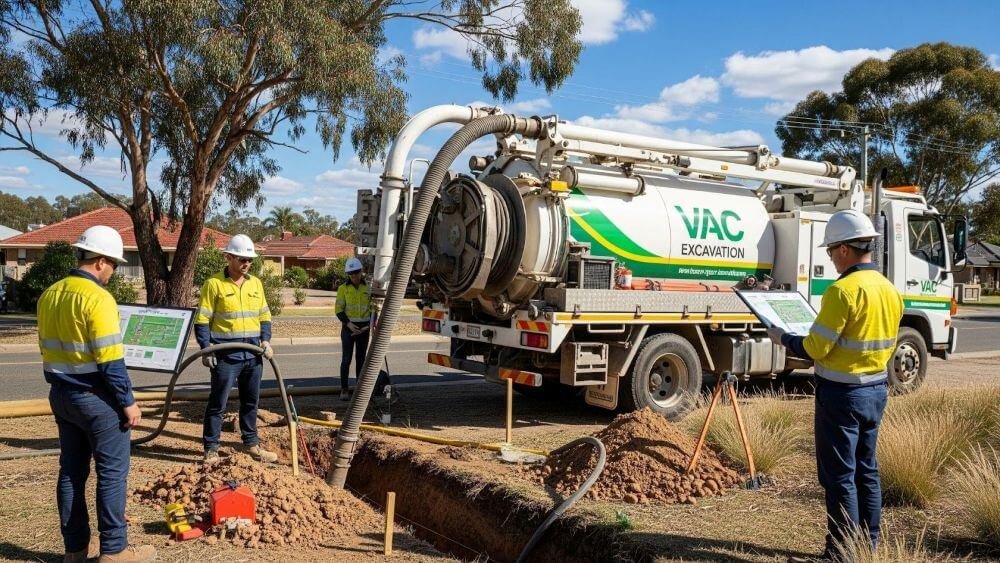
Vacuum excavation plays a critical role in how utility works are planned and delivered across Australia.
With underground services becoming more congested and project timelines under increasing pressure, planners and contractors need methods that reduce uncertainty before major works begin.
Vacuum excavation provides accurate ground information early in the planning phase, supporting safer decisions, clearer scopes and more reliable project outcomes.
This article explains how vacuum excavation is used to plan utility works in Australia and why it has become an essential tool for modern infrastructure and maintenance projects.
The importance of planning in Australian utility works
Utility works in Australia are governed by strict safety, environmental and asset protection requirements.
Electricity, gas, water, sewer and telecommunications networks often run close together, particularly in metropolitan and older regional areas.
Inaccurate service information can lead to redesigns, delays and serious safety incidents.
Effective planning reduces these risks by confirming what is actually in the ground before construction begins.
Vacuum excavation enables planners to move beyond assumptions and outdated records, replacing them with verified site data.
Using hydro vacuum excavation to confirm service locations
Vacuum excavation is commonly used during the planning stage for potholing and service exposure. This process allows crews to safely uncover utilities at specific points without damaging them.
The information gathered can then be used to validate drawings, adjust alignments and determine appropriate construction methods.
In Australia, where asset records may vary in accuracy depending on the age and location of the network, this confirmation step is vital.
Vacuum excavation helps planners understand depth, alignment and material type, which directly influences design decisions and construction sequencing.
Improving safety outcomes through early investigation
Planning utility works is not only about efficiency, especially when underground utilities where traditional excavation methods might cause damage are involved.
Safety is a core driver behind the use of vacuum excavation during early investigations.
Reducing unknown risks before construction
Unknown underground conditions are a major contributor to incidents on Australian worksites.
By using vacuum excavation during the planning phase, many of these unknowns are removed before heavy plant arrives on site.
When services are positively identified and visually confirmed, risk assessments and safe work method statements can be developed with greater accuracy.
This leads to safer excavation strategies and clearer instructions for crews once construction begins.
Supporting safer design decisions
Vacuum excavation data allows engineers and designers to plan around existing assets rather than reacting to them during construction.
Adjustments to trench alignments, footing locations or installation methods can be made early, reducing the need for last minute changes that often introduce safety risks.
Enhancing efficiency and project certainty with Non destructive digging
Accurate planning has a direct impact on project timelines and budgets.
Vacuum excavation contributes to this by providing reliable information that supports realistic scheduling and resource allocation.
Minimising rework and delays
Unexpected services are a common cause of delays on Australian utility projects.
When vacuum excavation is used during planning, the likelihood of encountering surprises during construction is significantly reduced.
This proactive approach helps avoid stoppages, redesigns and the need for emergency service coordination.
As a result, projects are more likely to progress according to plan, benefiting clients, contractors and the wider community.
Better coordination with asset owners
Utility works often require close coordination with multiple asset owners.
Vacuum excavation provides clear, visual confirmation of asset locations, making discussions with these stakeholders more straightforward.
Accurate exposure data supports permit applications, approvals and shutdown planning.
It also builds confidence with asset owners that works can proceed safely, which can streamline the approval process.
Adapting planning approaches to Australian conditions
Australia’s diverse environments present unique challenges for utility planning. Soil types, climate and access conditions vary widely between regions.
Vacuum excavation is adaptable to these conditions, making it suitable for use during planning in both urban and remote settings.
Whether dealing with reactive clay, sandy soils or compacted road bases, the controlled nature of vacuum excavation allows planners to obtain consistent results.
Planning works in live environments
Many Australian utility projects take place in live environments such as roads, rail corridors and public spaces.
Vacuum excavation allows investigation works to be carried out with minimal disruption.
Because excavation can occur from a distance and produces limited surface spoil, traffic management requirements are often reduced.
This supports safer interactions with the public during the planning phase and helps maintain access for businesses and residents.
Supporting compliance and documentation
Australian construction projects require extensive documentation to demonstrate due diligence and risk management.
The vacuum excavation process can support this by providing clear evidence of underground investigations.
It’s part of why people across the country find it a suitable vacuum system to follow.
Photos, measurements and service confirmations gathered during vacuum excavation can be incorporated into planning reports and design documentation.
This strengthens compliance with regulatory expectations and provides a defensible record if issues arise later in the project.
Why vacuum excavation is now standard practice in planning
Across Australia, vacuum excavation is increasingly viewed as a standard planning tool rather than an optional extra.
Its ability to deliver accurate information, improve safety and support efficient decision making has made it a trusted part of utility project preparation.
By integrating vacuum excavation into the planning phase, project teams gain greater certainty, reduce risk and set their works up for success.
As utility networks continue to expand and age, this approach will remain central to responsible and effective infrastructure delivery in Australia.